
1 Introduction

This is the first of the five parts on my posts about the 9th ASEP StructWhiz Challenge.
The 9th ASEP StructWhiz Challenge just concluded yesterday at the time of this writing, and it was an amazing experience being part of the Organizing Committee, more specifically being in charge of the technicals, and creating and reviewing questions for the competition.
For context, the ASEP StructWhiz Challenge is a college-level quiz bee competition organized by the Association of Structural Engineers of the Philippines, Inc. (ASEP), which covers topics in the field of structural engineering. The competition consists of two parts: a written Elimination Round to determine the top 20 participants, and an oral Final Round to determine the top 3 winners.
In this article and the next ones, I will be sharing some of the questions that I proposed for this competition which I think are interesting, as well as the solutions to each of these. These questions may seem to be difficult for competitions like this, like many people are telling me for many years now. But personally, I firmly believe that these questions set apart contestants who are really prepared for possible questions, who have creative and critical thinking skills, who know their way around formulas and how these formulas can be twisted around, and who have the patience and determination to tackle these problems, as a strong quizzer should be.
2 Problem
Problem
From the 9th ASEP StructWhiz Challenge, Final Round, Difficult, Question #4 (90 seconds)
A three-level high-ceiling steel moment frame structure has equal seismic weights and floor-to-floor heights in each level. The levels are consecutively numbered as 1, 2 and 3, respectively, with 3 being the topmost level. Using equivalent lateral force procedure, Engr. Jaydee calculated that the lateral force in levels 1 and 3 are 150 kN and 550 kN, respectively. Using Method A to calculate structure periods, what is the total height of the structure in meters?
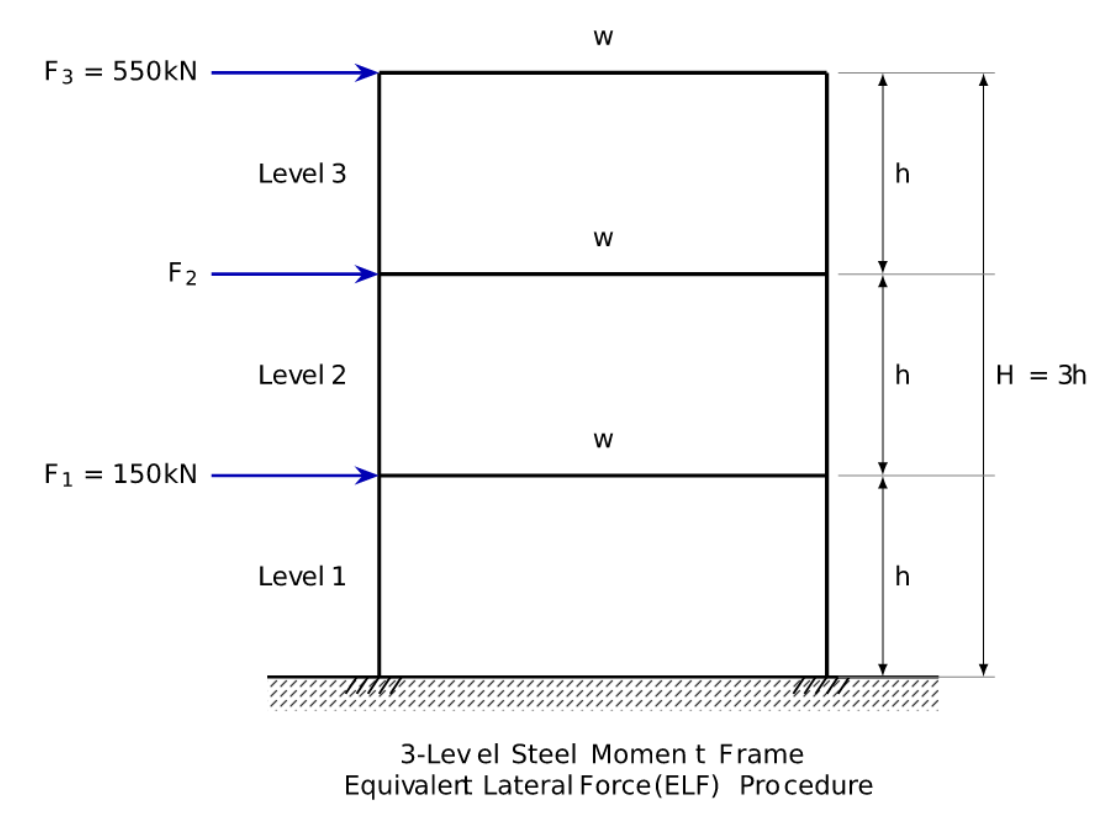
3 Formulas
We are being asked to find the total height of the structure. If we know the height of that structure, we can calculate its period using Method A:
We have \(C_t=0.0853\) for a steel moment frame structure.
Next, we can calculate the lateral force at any floor level \(i\) using the equivalent lateral force procedure:
except this only applies to levels other than the topmost level. At the topmost level, there is an additional \(F_t\) that needs to be included:
Now, \(F_t\) is defined as equal to zero when the period \(T \leqslant 0.7\text{ sec}\) and is equal to the smaller of \(0.07TV\) and \(0.25V\) when \(T > 0.7\text{ sec}\).
4 Solution
Since the height of the structure is not given, but the lateral forces at levels 1 and 3 are given, we will run through these formulas in reverse. Starting with equation (2), we express the lateral force in level 1 as
We can simplify this. From the given, we know that the levels have the same seismic weights, so that
We also know from the given that the levels have the same floor-to-floor heights. If we let that floor-to-floor height be \(h\), then we get
Since \(F_1=150\text{ kN}\) from the given, then equation (4) becomes
Now, using equation (3), we can write the lateral force in level 3 as
and since \(F_3 = 550\text{ kN}\), this simplifies to
Equations (7) and (9) are a system of two linear equations in two variables. Solving these simultaneously we get the base shear \(V=1000\text{ kN}\) and, more importantly,
Since \(F_t > 0\), we are guaranteed that \(T>0.7\text{ sec}\). Also, since \(F_t=100\text{ kN} < 0.25V=0.25(1000)=250\text{ kN}\), we know that \(0.25V\) does not govern, and so the formula \(0.07TV\) governs.
From there, we can now calculate for the period \(T\) from the formula
It is clear that \(T > 0.7\text{ sec}\), which checks. Finally, we can now calculate for the total height of the structure using equation (1):
Comments
Loading comments…