
1 Problem
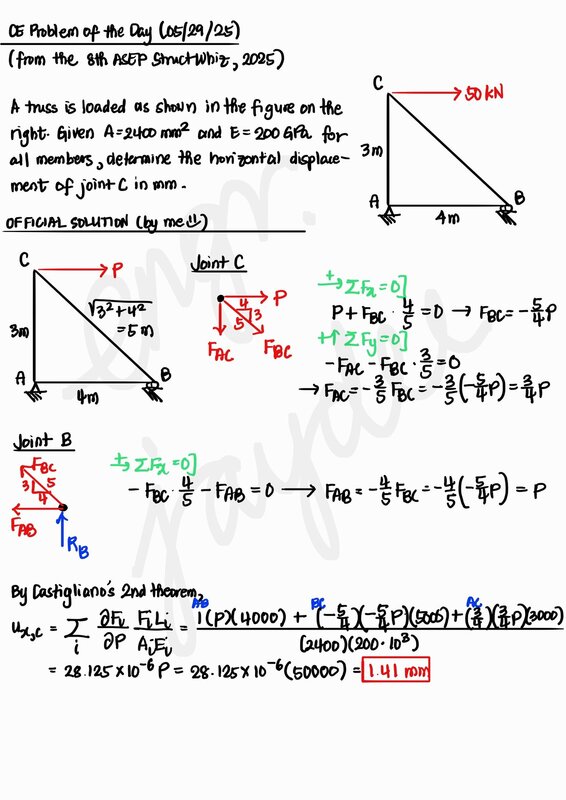
(From the 8th ASEP StructWhiz, 2025)
A right-angled truss is loaded with a horizontal force at joint C. Given a cross-sectional area \(A = 2400\text{ mm}^2\) and a modulus of elasticity \(E = 200\text{ GPa}\) for all members, determine the horizontal displacement of joint C in millimeters.
Given
- Truss Geometry: Right triangle with vertical member \(AC = 3\) m, horizontal base member \(AB = 4\) m. (By Pythagorean theorem, diagonal member \(BC = 5\) m).
- Support Conditions: Pin support at A, roller support at B.
- Applied Load: \(50\) kN horizontal force acting to the right at joint C.
- Material Properties: \(A = 2400\text{ mm}^2\), \(E = 200\text{ GPa}\) for all members.
Required
- Horizontal displacement of joint C (\(u_{x,c}\)).
2 Solution
1. Methodology: Castigliano's Second Theorem
To find the displacement at a specific joint using Castigliano's Second Theorem, we evaluate the partial derivative of the total strain energy with respect to the applied load at that joint. For a truss, the theorem is expressed as:
\[u_{x,c} = \sum_{i} \left( \frac{\partial F_i}{\partial P} \frac{F_i L_i}{A_i E_i} \right)\]Where:
- \(P\) is the horizontal load applied at joint C. We will keep \(P\) as a variable for the equilibrium equations and substitute \(P = 50\text{ kN}\) at the end.
- \(F_i\) is the internal axial force in member \(i\) in terms of \(P\).
- \(L_i\) is the length of member \(i\).
- \(A_i E_i\) is the axial rigidity of member \(i\).
Because \(A\) and \(E\) are constant for all members, they can be factored out of the summation.
2. Equilibrium Analysis (Method of Joints)
We must find the internal forces (\(F_{AC}\), \(F_{BC}\), \(F_{AB}\)) in terms of the applied load \(P\).
Joint C
Applying equations of static equilibrium at the loaded joint. Note that the slope of member BC is a 3-4-5 triangle ratio.
Sum of forces in the x-direction:
\[\sum F_x = 0\] \[P + F_{BC} \left( \frac{4}{5} \right) = 0 \Rightarrow F_{BC} = -\frac{5}{4}P\]Sum of forces in the y-direction:
\[\sum F_y = 0\] \[-F_{AC} - F_{BC} \left( \frac{3}{5} \right) = 0\] \[F_{AC} = -\frac{3}{5} \left( -\frac{5}{4}P \right) = \frac{3}{4}P\]Joint B
Analyzing joint B to find the internal force for the bottom member, AB.
Sum of forces in the x-direction:
\[\sum F_x = 0\] \[-F_{BC} \left( \frac{4}{5} \right) - F_{AB} = 0\] \[F_{AB} = -\frac{4}{5} \left( -\frac{5}{4}P \right) = P\]3. Calculation of Displacement
Now we calculate the individual terms for Castigliano's summation. It's helpful to organize this data (with lengths converted to millimeters to ensure consistent units: N and mm).
- \(L_{AB} = 4000\text{ mm}\)
- \(L_{BC} = 5000\text{ mm}\)
- \(L_{AC} = 3000\text{ mm}\)
Applying the summation formula:
\[u_{x,c} = \frac{1}{AE} \left[ \left(\frac{\partial F_{AB}}{\partial P}\right) F_{AB} L_{AB} + \left(\frac{\partial F_{BC}}{\partial P}\right) F_{BC} L_{BC} + \left(\frac{\partial F_{AC}}{\partial P}\right) F_{AC} L_{AC} \right]\]Substitute the expressions found in step 2:
\[u_{x,c} = \frac{(1)(P)(4000) + \left(-\frac{5}{4}\right)\left(-\frac{5}{4}P\right)(5000) + \left(\frac{3}{4}\right)\left(\frac{3}{4}P\right)(3000)}{(2400)(200 \times 10^3)}\]Simplify the numerator:
\[u_{x,c} = \frac{4000P + 7812.5P + 1687.5P}{480 \times 10^6} = \frac{13500P}{480 \times 10^6}\] \[u_{x,c} = 28.125 \times 10^{-6} P\]4. Final Answer
Substitute the actual load value \(P = 50\text{ kN} = 50,000\text{ N}\) into the simplified equation:
\[u_{x,c} = 28.125 \times 10^{-6} (50000) = 1.40625\text{ mm}\]Final Answer: The horizontal displacement of joint C is 1.41 mm (directed to the right).
Comments
Loading comments…